|
|
|
|
|

|
Local
Localities across the D.C. have been quietly closing a key window into public safety communications under a region-wide plan to encrypt police dispatch calls. Arlington could be next, depending on what local leaders decide. A recommendation from the Washington Metropolitan Council of Governments, a regional advisory body of local governments in D.C., Northern Virginia and Maryland, calls for all local law enforcement to switch to encrypted communications by 2028. Officials declined ARLnow’s requests to release the plan guiding the decisions, citing security concerns. But a number of local governments in the D.C. area appear to have followed the recommendation in recent months, citing concerns about the privacy of crime victims and technical considerations around region-wide coordination.
|
|
|

|
Local
Lynchburg Vice Mayor Curt Diemer is accused of using a fake social media account to praise himself and some colleagues while criticizing others, after photos of him appeared on an account with a different name in late October. … [The “Jordan Jones” Facebook] account is private, so posts reviewed by Cardinal News have been provided via screenshots. Comments on public pages were accessed on Facebook. … The Jones account has posted more than 200 comments on city council meeting livestream videos on the city’s Facebook page since 2025, according to documents and screenshots Faraldi provided. Jones also made comments on other Facebook pages, including Faraldi’s, where local government topics are discussed. … Several comments posted by Jones are critical of Faraldi, Reed and Taylor — the three Republicans often seen on one side of a GOP divide, opposite Diemer, Misjuns and council member Jacqueline Timmer. … More recently Megan Duncan, an associate professor at Virginia Tech’s School of Communication who researches social media and politics, there’s been a deprofessionalization of the way politicians treat social media and the start of an “era where we see a lot of politicians using their social media to cultivate a culture.” That online community can be healthy for democracy because there is more two-way communication between leaders and their constituents and among constituents who are engaging in conversations about governance, Duncan said.
|
|
|
|
Local
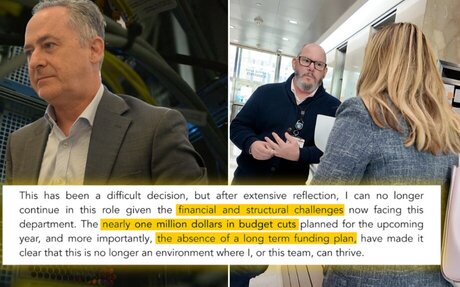
Before a cyberattack knocked Richmond Public Schools’ network offline this fall, two of the school division’s most recent technology directors had resigned, with one warning of significant financial and structural challenges and the other saying “foundational changes” and “necessary reforms” were needed. Resignation letters obtained by CBS 6 through a Freedom of Information Act request provide a new look at concerns inside the school division’s Technology Services department before the attack.
|
|
|

|
Local
Albemarle County School Board Member Ellen Osborne has resigned. The board’s vice chair and Scottsville District representative is the third school board member to resign since August amid an ongoing sexual misconduct scandal that has rocked the school division since the start of the year. … Osborne’s resignation is effective Dec. 1, and “the board will meet to discuss how to fill the vacancy and will share its decision with the public,” per a school division statement. … To this day, the school division has declined to tell the public how many employees are on leave, with speculation ranging from as few as a dozen to as many as 40.
|
|
|

|
Commentary
As requests pile up, FOIA professionals struggle to make the determinations generally required within FOIA’s 20-working-day statutory period. One analysis found that, on average, requesters with pending FOIA submissions waited more than 240 days to hear back. Delayed determinations can also increase litigation risk, adding cost and work for already overburdened teams. AI can help workers parse records, route requests, review documents, support redaction and surface the right information. But it’s a catch-22: That same technology can also help requesters research agencies, draft requests and submit them at greater scale. One federal practitioner recently reported seeing 50-100 requests arrive within moments from the same requester, and other practitioners have described similar experiences. These accounts are anecdotal, but they illustrate how AI-assisted submissions could place additional pressure on workflows designed to process requests individually.
|
|
|
|
|
|
|
|
|