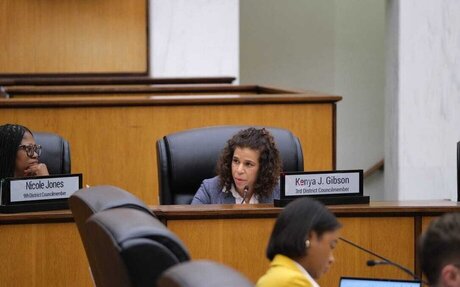
Richmond officials stopped following a City Council-approved transparency law seven years ago. After an earlier delay on proposals to address the issue, the Council still hasn’t decided what to do about it. On Wednesday, a Council committee discussed the possibility of initiating a formal investigation into the city’s failure to publish a monthly payment register. That proposal has been put forward by Councilor Kenya Gibson (3rd District), who regularly pushes for more outside oversight of city operations. This week, the Council’s Finance and Economic Development Committee voted to put off the investigation request until its July meeting. In May, the same committee chose to put off the matter until June.
How you look at something – the frame you use and your perspective – often influences what you see. This holds true with the issue of data centers and water use. Amazon recently reported that it withdrew a total of 2.5 billion gallons of water for data center cooling operations in 2025. That seems like a lot of water. But Amazon also points out that Americans used 3.3 trillion gallons of water that same year to grow their gardens and lawns. The company apparently wants to assure you that the water it uses for its data center operations, in comparison to other uses of water across our very large country, is not such a big deal. Of course, Amazon doesn’t operate its data centers across the entire nation. It does so in only a few states, and nowhere at higher concentration than in Virginia. We wanted to learn for ourselves how much water local communities have promised to Amazon for data center cooling in our part of the state, the region between Northern Virginia and Richmond, including Louisa, Spotsylvania, Caroline and Stafford Counties. By scouring available public records and submitting Freedom of Information Act requests, we learned that local governments in the commonwealth have allocated at least 19.6 million gallons a day to Amazon.
A bill winding its way through Sacramento right now would make some of the biggest changes in decades to the California Public Records Act — the 58-year-old state law that guarantees everyone has access to government documents and data. Proponents argue AB 1821 is necessary to help local governments weather a deluge of burdensome requests that have swamped cities and other local agencies. But the changes it proposes have alarmed First Amendment groups, many news organizations, and government watchdogs, who worry it will allow officials to delay handing over records and impose financial barriers to information access. … As it now stands, AB 1821 would give government officials the power to treat some records requests as “commercial” in nature and charge requesters fees. It would also allow local governments to file suit against any requester they believed was operating with “malicious intent.” A judge could then impose fees. Those fees would cover the time it takes a local government’s staff to find and review public records before handing them over and could be assessed at anywhere from $22 to $66 per hour.