|
|
0 8 . 1 7 . 2 6
All Access
9 items
Surprise! There were so many interesting stories over the weekend, that I couldn’t resist sending a newsletter out today even though I said Friday that there wouldn’t be one. But tomorrow — no newsletter tomorrow.
|
|
|

|
Local
Twenty-eight people signed up at Thursday night’s Shenandoah County School Board meeting to speak about two Quicksburg schools named after Confederate generals. Nothing on the agenda said a vote was coming. … After 11 p.m., following a closed session that ran nearly 2 1/2 hours, the board added it and voted 6-0 to proceed with an appeal. A second motion, also 6-0, authorized appellate counsel to challenge Senior U.S. District Judge Michael F. Urbanski’s judgment and any other rulings the attorneys determine should be reviewed, to file a notice of appeal, and to seek a stay on changing the names while the case is pending. … A law that took effect July 1 generally bars public bodies from taking final action on items added to an agenda after a meeting begins. It makes exceptions for time-sensitive matters and matters that were the subject of a closed meeting properly identified in a motion. The board has not said whether it relied on the time-sensitive exception, the closed-meeting exception or both.
|
|
|
|
Local
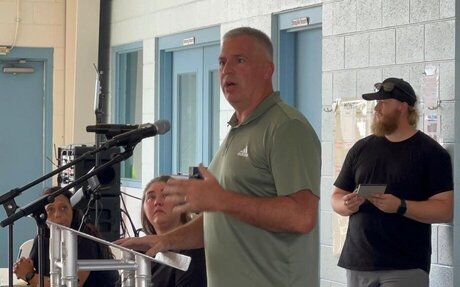
Project Flash, a data center proposed last year for Summit View Business Park, is no longer moving forward in Franklin County. Boone District Supervisor Mike Meredith made the announcement during a community meeting held Sunday to discuss the proposed data center. He addressed the more than 200 in attendance at the Scruggs Volunteer Fire Department. … Secretive negotiations between Franklin County and data center developer Crusoe have been ongoing since before November, according to documents county residents obtained through the Virginia Freedom of Information Act. References and details about Project Flash were uncovered by the Franklin County Community Coalition, which organized Sunday’s meeting.
|
|
|

|
Local
Roanoke residents are speaking out about Flock cameras — automated license plate readers that some say are a valuable public safety tool, while others warn they go too far when it comes to personal privacy. … For some community members, the concern goes beyond what the cameras collect — it’s about how contracts are approved in the first place. Jack Leff, who led a Freedom of Information Act workshop on the issue, says many of these deals happen without enough public input. “So especially with the context of Flock, a lot of these deals are happening behind closed doors without the public knowing until it’s far too late. And so using FOIA, the Freedom of Information Act, to actually get access to that information sooner will make it a lot easier for concerned community groups to actually see what’s going on to make an informed decision about their communities,” Leff said.
|
|
|
|
Local
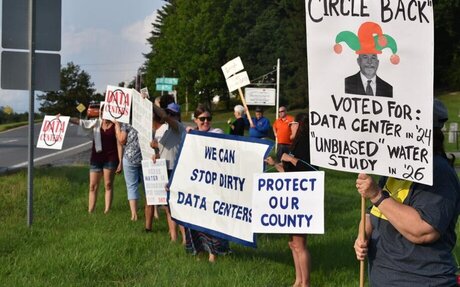
Botetourt County Supervisor Tim Snyder did not allow members of the media to enter his data center-focused town hall Thursday evening, which was set to include a presentation and question-and-answer session from Google representatives. The town hall, held at the VFW Post 1841 in Daleville, was advertised on Facebook as being open only to Amsterdam District residents. In a statement sent to The Roanoke Times on Friday, Snyder said the town hall was an opportunity for residents in his district to hear from Google representatives about the data center campus planned for the county, which would be located in their district. When reporters from The Roanoke Times, WSLS and WDBJ approached the door, about 15 minutes before the meeting began at 7 p.m., Botetourt County Director of Communications Brent Watts told them that Snyder was not allowing members of the media to enter.
|
|
|

|
Local
Judging by correspondence sent to Fredericksburg School Board members through Aug. 7, there is strong community support for one of the five applicants to fill the vacant seat on the board — Stan Jones. … The Free Press requested correspondence, including emails and text messages, sent to board members in support of any candidate for appointment as the interim at-large representative. … At a special meeting on Aug. 3 to hear from the applicants, school board members praised the qualifications of all five. With the exception of Kay, they also noted that there is “very clear public support for one of the candidates,” as at-large representative Molly McFadden said, referencing Jones. Kay said that her Ward 4 constituents “don’t support [Jones].” According to the FOIA request, Kay received emails from 10 Ward 4 residents in support of Jones, sent beginning Aug. 6 to her School Board address. She also forwarded to the division’s FOIA officer, Mike George, one email in support of Jones that had been sent to her personal email address on Aug. 5.
|
|
|

|
Local
Richmond officials on Thursday evening announced a revamped process for disbursing funds to charitable organizations. The announcement comes after an internal audit found officials under former Mayor Levar Stoney had awarded nearly $1.5 million to ineligible nonprofits, trashed documents in violation of state law and shown favoritism under the city’s nondepartmental grants program. … “Nonprofits will no longer apply directly to the city each fall,” city spokesperson Tamara Jenkins said in a statement. “Instead, three competitively selected grantmaking partners will manage open, competitive application processes across the city’s four priority areas: arts and culture, children and families, economic mobility and health.”
|
|
|

|
Local
In the spring of 2024, a local real estate firm sued the city of Richmond, claiming officials had erroneously jacked up the tax bill on about 18 acres of industrial property near the Port of Richmond. City Hall ultimately agreed to correct the issue by lowering the assessed property values for the three affected parcels and issuing a $37,152 tax refund to the company, developer Charles Macfarlane’s CK-Klein-Macfarlane, making amends for overpayments. The broad terms of that deal were settled in October 2025. But according to court documents, the city’s own lawyers couldn’t get the embattled Finance Department to calculate the exact amount the taxpayer was owed and issue the refund. The delay was costing the city about $10 a day by adding to the interest owed to the company, as Macfarlane’s attorney made clear in more than a dozen emails prodding the city to follow through on the agreement.
|
|
|

|
Federal
The Consumer Financial Protection Bureau will cease publication of unverified complaint narratives and visualizations, arguing the utility of publicizing narratives is minimal “while often causing confusion and providing misleading data,” according to an announcement. The CFPB began publishing consumer complaint narratives in its Consumer Complaint Database in 2015. Consumers could choose whether to provide narratives along with their complaints, and the bureau scrubbed all identifying information about the person submitting the narrative before publication. In a statement today, the bureau noted it retains full discretion over whether to publish the narratives and has several concerns about their usefulness and fairness. … Still, the CFPB said it considers previously published narratives to be subject to the Freedom of Information Act and therefore are subject to FOIA disclosure.
|
|
|

|
Federal
President Donald Trump claimed in 2019 that he was “the most transparent president in history.” Throughout his second term, Trump’s spokespeople have used that phrase over and over again. The administration has made a big show of opening the archives on old mysteries: the assassination of President John F. Kennedy, the existence of UFOs, and the case of well-connected sex predator Jeffrey Epstein. While the JFK files included some genuinely shocking revelations, the UFO files were thin on substance. And the Epstein files turned into an infamous boondoggle. … But the Trump administration has also fouled up the everyday mechanisms for Americans to see what their leaders are up to and how their tax dollars are being spent. Officials have tried to hide documents from the Freedom of Information Act (FOIA) or outright exempt government activities from FOIA. In fiscal year 2025, the federal government granted a little under 50 percent of FOIA requests, a record low since 2010, according to data compiled by The New York Times. The Department of Justice fought in court to overturn the Presidential Records Act, which requires the White House to preserve its files for posterity.
|
|
|
|
|
|
|
|
|