|
|
0 8 . 2 8 . 2 6
All Access
7 items
|
|
|

|
Statewide
A Williamsburg resident in March asked the police department at the College of William & Mary how data collected by the school’s Flock Safety surveillance system is shared. Police Chief Don Butler asked Flock for the answer, according to records obtained by the Virginia Center for Investigative Journalism at WHRO. “I’m trying to be transparent with some folks who would rather we didn’t have Flock cameras,” Butler wrote to the company, “and want to make sure I tell them correctly.” Flock Safety vice president Chris Colwell replied several days later with a list of talking points, each one with a supposed question and scripted answer. … The email exchange was revealed in the thousands of public documents obtained by the Virginia Center for Investigative Journalism at WHRO from Norfolk, Alexandria, Mecklenburg and Fairfax counties. VCIJ’s requests sought correspondence and materials related to the operation of Flock cameras, sent by residents to public officials or police departments, or exchanged between officials and residents.
|
|
|

|
Local
After reviewing draft lease documents related to the library’s potential move, a Rappahannock County Circuit Court judge ruled Thursday that the documents could be withheld from public view — siding with the Rappahannock County Public Library Board of Trustees. The decision came just hours before a deadline — the board’s monthly meeting at 4:30 p.m. today (Aug. 27), when a vote could be taken on the move. Several Rappahannock residents — represented by attorney David Konick — had filed a lawsuit this month seeking to compel the Board of Trustees to make the documents public, arguing that their withholding violated the Virginia Freedom of Information Act (VFOIA). … Konick had requested a copy of the draft lease, meeting minutes and other records related to negotiations with Black Kettle LLC, the developer overseeing the Rush River Commons project, where a new library could be constructed — a request which was denied by the board. … Jeremy Capps, representing the library board, countered that the board is exempt from releasing documents tied to active negotiations, arguing public disclosure could jeopardize its bargaining position.
|
|
|
|
Local
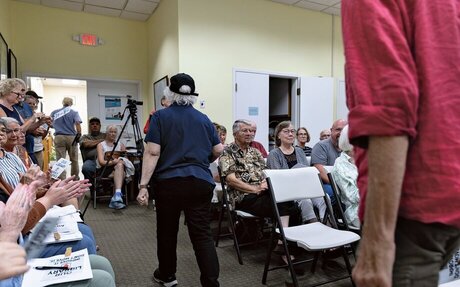
The Rappahannock County Public Library Board of Trustees pledged Thursday to seek public comment on a proposed lease for a new library at Rush River Commons. … The public portion lasted one hour. Then the board deliberated privately for 90 minutes before making the announcement. … “We will read them all,” Board President Victoria Fortuna said of public comments, “and we will consider them.” … At least three Rappahannock sheriff’s deputies attended the meeting at the request of Assistant County Administrator Bonnie Jewell, who serves on the library board. Officers have not been present at any library board meeting the Rappahannock News has attended in the past two years. About 10 people spoke during a public comment period, nearly all in opposition to the move. The board limited the public comment period to about 20 minutes, and set a timer for two minutes per speaker. … Board members stressed after their private deliberations, when every member of the public had gone home, that it would consider keeping the library at its current site. But staying would come at a steep cost, they said.
|
|
|
|
Local
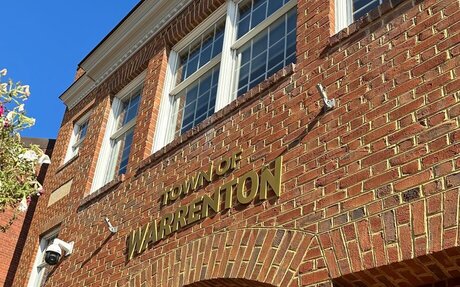
Some members of Warrenton’s Commission on Open and Transparent Government believe they may be back on the right track toward delivering real results – and they think artificial intelligence can help. … According to Ward 2 Councilmember and Vice Mayor Bill Semple, the chair of the commission, the project burned through more than half of the $60,000 allotted for counsel and IT help before producing any meaningful work product. … Lyndie Paul, a spokesperson for the town government, gave a breakdown Tuesday of the money the commission has spent. The commission shelled out more than $34,000 to former special counsel Whit Robinson’s law firm, just over $9,000 of which was spent on an IT expert, leaving slightly less than $26,000 remaining. In reality, the real cost of the project is much higher, as that expenditure does not include town attorney fees. So far, $26,706.25 has been paid to former Town Attorney Chap Peterson, with another $37,161.71 having gone to current Town Attorney Philip Strother through July – a number that will likely continue to go up.
|
|
|

|
Local
The MGM Grand Hotel & Casino in Las Vegas hosted NAVIGATOR 2026, the International Academies of Emergency Dispatch conference, April 21–24. Stafford County bought four all-inclusive packages — conference passport, three nights’ hotel and airfare — through its Priority Dispatch contract, then issued $233 county per diem checks to the four emergency-communications employees who attended. Stafford County’s Sheriff’s Office sent four emergency-communications employees to a Las Vegas 911 conference this spring under a package Stafford bought with public funds — airfare, hotel and registration billed by the software vendor — then cut each of them a $233 county check for meals. Attendance, the office, and the vendor all say it is not required. The county’s quote still prices four of those packages every year for five years. … Nothing on the quote treats the trips as a complimentary perk. Stafford County is the buyer. The Navigator packages are priced as line items on the same public contract as the 911 software.
|
|
|
|
Local
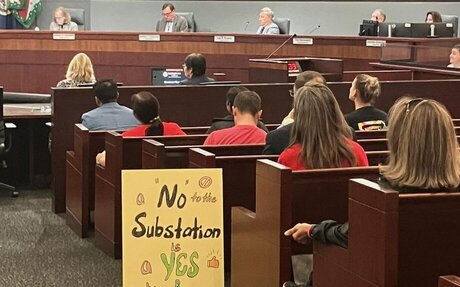
Some Loudoun County government meetings are nearly empty, the rows of board room benches in Leesburg populated with a handful of county staff members and one or two public speakers. Other times, the room is packed. Speakers sign up in droves, wear matching T-shirts, bring signs — it’s not uncommon to see a contentious issue draw a crowd. Sit through enough Board of Supervisors meetings, spend enough hours sifting through dense policy discussions, and you start to learn the basics of how it all works. Government at any level can be complicated, and Loudoun County isn’t an exception. But county government is also incredibly influential in what your day-to-day life looks like here in Loudoun.
|
|
|

|
Federal
Documents obtained by The Guardian and The Associated Press indicate that Robert F. Kennedy Jr. lied to Congress when he said that his 2019 visit to Samoa ahead of a deadly measles outbreak had “nothing to do with vaccines.” The records were recently released by the U.S. Department of State in response to a Freedom of Information Act lawsuit Reporters Committee attorneys filed on behalf of the AP and reporter Michelle Smith. The newly disclosed documents include a letter in which Kennedy told Samoan officials ahead of his visit that he wanted to study the measles, mumps, and rubella vaccine in the Pacific island nation. In the January 2019 letter, which mentions the word vaccine or vaccination eight times, Kennedy suggested that manufacturing issues with MMR vaccines may have led to the deaths of two children who had received the shots, The Guardian and the AP reported on Thursday. He proposed having his team at the anti-vaccine group Children’s Health Defense “conduct detailed health informatics assessment in Samoa of what happened with your MMR vaccines.”
|
|
|
|
|
|
|
|
|