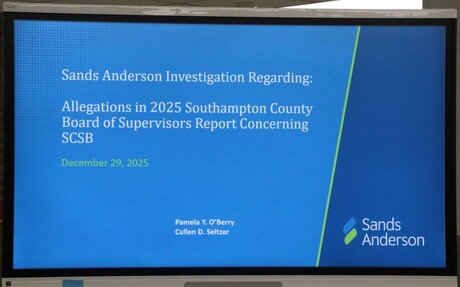
Sands Anderson attorneys representing the Southampton County School Board (SCSB) shared a presentation Monday, Dec. 29, directly disputing recent allegations of poor financial and administrative management made against Southampton County Public Schools (SCPS) leadership. … One of the most significant parts of attorney Pamela Y. O’Berry’s presentation came when she shared correspondence to support the assertion that the BOS-requested investigation report falsely attributed the loss of a $5.5 million School Construction Assistance Program (SCAP) grant to the SCSB “despite demonstrable evidence of BOS responsibility for loss.” … The presentation from O’Berry and Cullen Seltzer included the [among] its visual slides: “3. Substantial compliance with Virginia Freedom of Information Act with opportunities for improved performance.”
Last year in this space we looked forward to topics we would be talking about in 2025. As we enter 2026, one remains atop the list, and is the perfect one to get us started: Fixing the city budget. … Also, one issue that will still be in the news in 2026 (and maybe beyond) began almost two years ago and seems to have no end. The circus began when Connie Clay, who served as the city’s FOIA officer, was fired in January 2024 as requests for information flooded in about the meals tax fiasco. She filed a whistleblower lawsuit in March of 2024, saying she was wrongfully terminated and claimed the city was not following FOIA law on many issues. The case is currently set to go to trial this summer. … The last legal bill to the city was in May 2025, after running up $234,000 in legal fees. Since then, they have not submitted one invoice to the city despite numerous hearings and filings since then. It’s entirely possible by the time the trial is concluded, it will have cost the city more than a million dollars.
In Michigan, municipalities are charging organizations and individuals money to process Freedom of Information Act (FOIA) requests, then taking the money and refusing to deliver the information. And it’s perfectly legal. It’s a loophole in the state’s FOIA law that doesn’t put a time limit on when government has to release information for which it has already charged people. On Dec. 11, the Michigan Court of Appeals ruled against the ACLU in a lawsuit involving the length of time the City of Grand Rapids took to release information requested in a FOIA. … “All parties agreed that defendant took 13 months to fulfill a FOIA request that needed only 3 hours and 30 minutes to process,” the court’s opinion stated. “They also agreed that, although FOIA contains deadlines for other actions, FOIA does not contain a strict deadline for the fulfillment of FOIA requests.”