|
|
0 1 . 1 5 . 2 6
All Access
7 items
Follow the bills we follow. VCOG’s annual bill chart is up and running
and will be updated daily throughout the legislative session.
Click here
|
|
|

|
State
For decades in Virginia, public and private developers who encroach on protected wetlands and streams have been required to offset the impacts by paying to restore similar ecosystems nearby. The Virginia Department of Transportation, for example, had to buy many credits to compensate for construction to expand the Hampton Roads Bridge-Tunnel. The process, called mitigation banking, operates as a marketplace where builders and restoration groups trade credits. But it has become somewhat of a black box, said Jonathan Rak, chief policy advisor for the Virginia Department of Environmental Quality. … The state recently launched a website to streamline the market by making this information more accessible. It’s produced in partnership with Water Ledger, a technology company focused on water management. The Stream, Wetland and Nutrient Credit Exchange, or SWaN, allows anyone to toggle through an interactive map and dashboard to find available credits by watershed and type, such as tidal or non-tidal wetlands. Market participants can register to use the platform more deeply for trading and research.
|
|
|

|
Local
Right after the Pledge of Allegiance — and without first adopting the night’s agenda for the Jan. 12 Mineral Town Council (MTC) meeting — council member David Hempstead made a motion to terminate the town’s contract with Town Manager Nicole Washington. Hempstead cited “with cause” as the reason for relieving her of the position as town manager, zoning manager, and clerk of the council. This action item was not advertised on the Jan. 12 agenda. Council member Bernice Kube seconded the motion, but council members Michelle Covert and Rebecca “Becky” McGehee argued that a public discussion was needed before a vote. Mayor Pam Harlowe replied that a public discussion would only cause a hostile environment, but let them speak. “I disagree that this needs to be done,” Covert said. “I don’t think it’s the appropriate place. It should have been on the agenda. We haven’t approved the agenda; [voting to terminate Washington’s contract] is not on the agenda. There is nothing that has been submitted to us to justify firing our town manager…we need to have significant consideration and evidence and not just [be] off-the-cuff firing people.”
|
|
|
|
Local
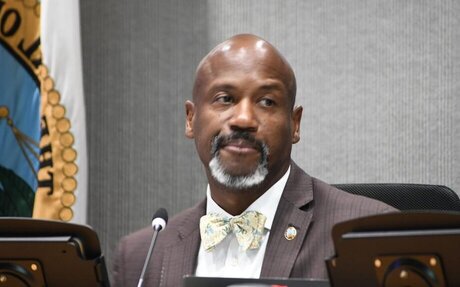
Prince William County will continue to defend the controversial PW Digital Gateway data center project in court as litigation costs mount over $1.6 million. A motion for reconsideration on $400,000 of additional funding for the county’s role in two Digital Gateway legal challenges and 17 real estate assessment cases related to the project failed in a 4-4 tie on Tuesday night, allowing the board’s Dec. 16 funding approval to stand. Gainesville Supervisor George Stewart initiated the motion while hoping to overturn the board’s prior vote from December where he voted in favor, calling the motion “fraught with errors” on Tuesday.
|
|
|
|
Local
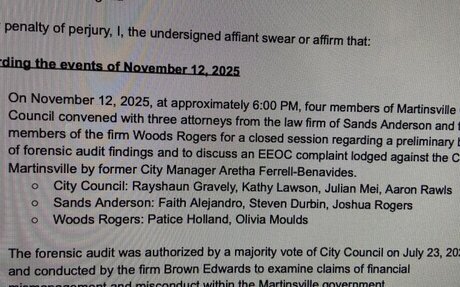
A citizen-led effort to remove Martinsville Mayor LC Jones from office advanced Tuesday with the filing of a petition containing approximately 420 signatures, exceeding the number required under Virginia law. Councilman Aaron Rawls also simultaneously made public a sworn affidavit detailing allegations of conflicts of interest, financial misconduct, interference with investigations and repeated incidents of intimidation and violence. … The petition lists multiple grounds for removal, including allegations that Jones engaged in conduct prohibited under the Code of Virginia, violated the state’s Conflict of Interests Act, failed to disclose or recuse himself from matters involving personal interests, and interfered with investigations and whistleblower protections. The petition also asks that Jones be suspended from office pending the matter.
|
|
|
|
Local
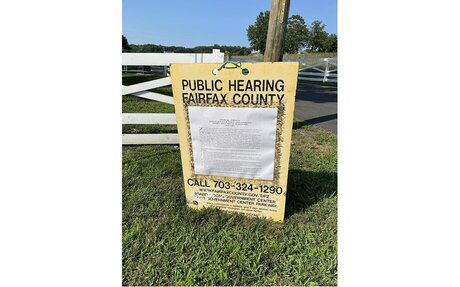
For decades, small yellow 18-by-24-inch public notice signs have been the primary signal of change in Fairfax County neighborhoods — standing as a paper bridge between a developer’s proposal and a resident’s right to know. But as traffic speeds have increased and neighboring jurisdictions have modernized, community leaders warn that Fairfax County’s signs have become “relics of the 20th century” that are physically difficult to read and impossible to understand, limiting knowledge. … In response to concerns, a Fairfax County spokesperson stated its signs are not intended to be a complete information source. “Posted signs are not required as part of the notice and advertising requirements for land use cases in Virginia. … Fairfax County’s Zoning Ordinance does require signs, as a way to alert the community that a land-use action is under review and to point people to where they can find full details. These yellow signs are not designed to be read in full, from a moving vehicle. Instead, they are one part of a broader notification process that also includes mailed notices, newspaper ads, and online postings,” the spokesperson added.
|
|
|

|
Editorial
In a rather odd chain of events, lawmakers passed a bipartisan bill in 2023 to make an annual report from the Judicial Inquiry and Review Commission available for public review for the first time ever, then did an about-face in last year’s session and passed a bill stipulating lawmakers must first read the report privately before deciding whether to share it with the rest of us. … But in the 2024 session, Sen. Creigh Deeds, D-Charlottesville, introduced a bill to reverse public disclosure of the commission’s decisions. He said judges deserved more consideration because “a lot of information available under the FOIA law right now is information that may not be accurate and may be defamatory toward a judicial officer.” That wasn’t at all true, however, as Deeds now acknowledges. It’s puzzling that lawmakers discussing the bill in the last session didn’t realize — or weren’t informed — that the annual report didn’t include outcomes of what the commission calls “unfounded cases.” … Secrecy should have no part of the disciplinary process for judges, no more than it should be for adult criminal defendants. But it’s been a Virginia tradition. According to the National Center for State Courts based in Williamsburg, Virginia is one of few states where judicial fact-finding hearings are not conducted in public. There is a screening process in Virginia, as in other states, to prevent unfounded cases from moving forward, so why aren’t proceedings open to the public here?
|
|
|

|
Nationwide
A handful of police departments that use Flock have unwittingly leaked details of millions of surveillance targets and a large number of active police investigations around the country because they have failed to redact license plates information in public records releases. Flock responded to this revelation by threatening a site that exposed it and by limiting the information the public can get via public records requests. Completely unredacted Flock audit logs have been released to the public by numerous police departments and in some cases include details on millions Flock license plate searches made by thousands of police departments from around the country. The data has been turned into a searchable tool on a website called HaveIBeenFlocked.com, which says it has data on more than 2.3 million license plates and tens of millions of Flock searches.
|
|
|
|
|
|
VCOG’s annual FOI awards nomination form is open.
Nominate your FOIA hero!
“Democracies die behind closed doors.” ~ U.S. District Judge Damon Keith, 2002
Follow us on: X / Facebook / Instagram / Threads / Bluesky
|
|
|
|