Data centers are driving interest in FOIA as I’ve never seen before
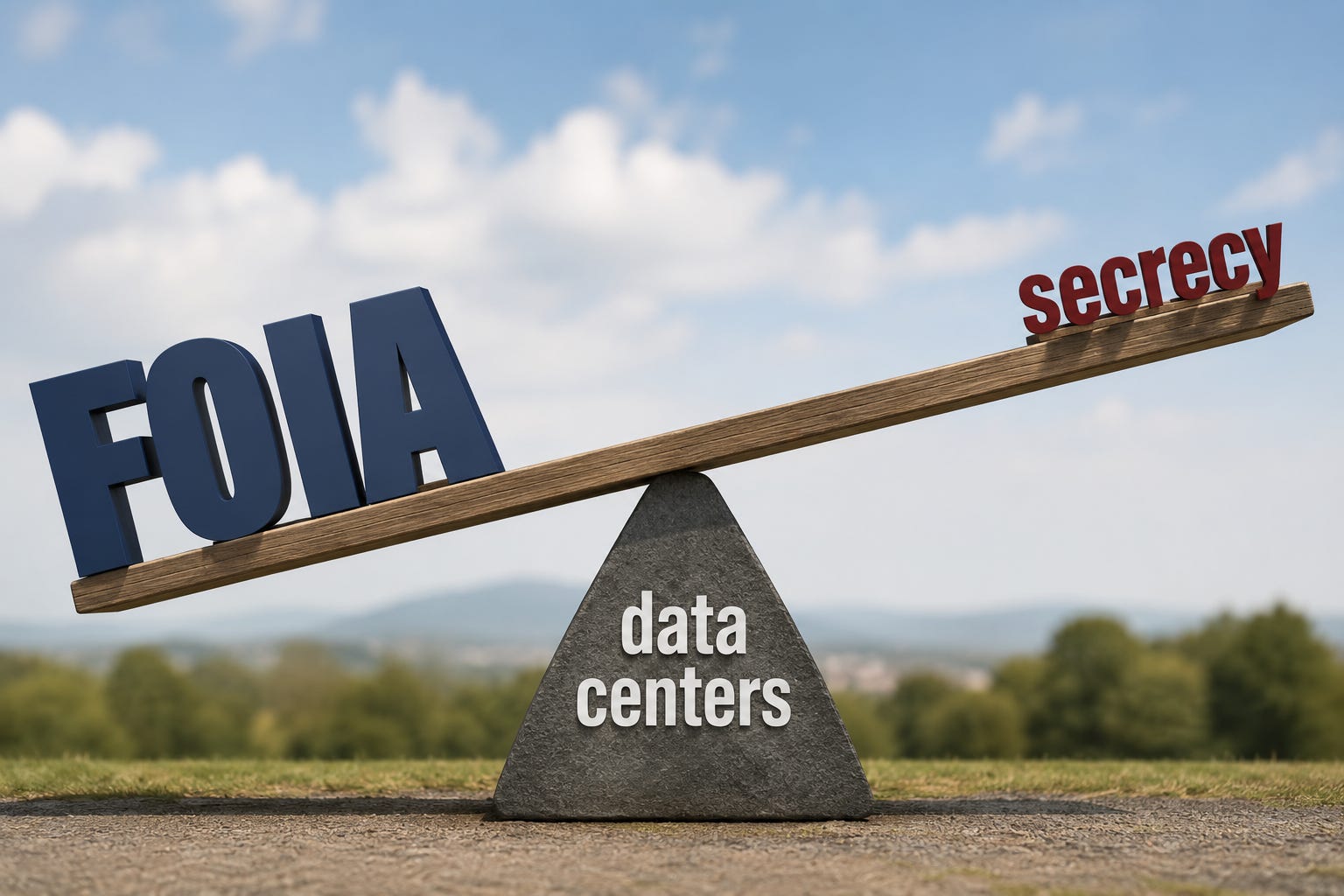
I’ve been at this FOIA thing in Virginia for well over mrm…mrm…mrm (covers mouth) years. Enough time to see FOIA scandals hit the news cycles, water coolers and town meetings and then fade away. Many have simmered and burned for months, while others have blazed white-hot for a short but intense time. Public interest in the power of the law that guarantees them access to government records and meetings ebbs and flows with each headline, but none of the storylines has had the sort of staying power needed to tip the balance in favor of an overall culture of transparency.
I wonder, though, if we might be on the cusp of such a tipping point.
As it is impacting every other news story of the day — from taxes, traffic, employment and noise, to water and electricity, property values and the fundamental character of communities — data centers are at the heart of it.
Political one-offs
In the early 2000s, former Governor Jim Gilmore got into a tussle with the Library of Virginia over turning over his papers to the state archivist, something most every one of his predecessors observed, and one that would have added his papers to an extraordinary trove of executive records going back to Patrick Henry. The library eventually got the records, and the public moved on.
The 2010s brought us two public corruption trials with FOIA at the center of both. Emails obtained through FOIA showed conversations between then-Delegate Phil Hamilton and Old Dominion University that prosecutors said showed he leveraged his seat on the House Appropriations Committee for a paid position at the university. In the case of former Governor Bob McDonnell, records secured through FOIA brought into question whether he and his family accepted gifts and cash in exchange for promoting a dietary supplement. The public cared a lot about the outcome of these cases, but that didn’t necessarily translate into a lasting love of Virginia’s public records act.
Staying with the governor theme, FOIA played a part in the Terry McAuliffe effort to keep under wraps a report about ABC agents’ arrest and roughing up of an underage UVA student. FOIA got a bit part in Ralph Northam’s “black-face” scandal, and it led to litigation against Glenn Younkin when his administration refused to turn over messages left on the “divisive concepts” parental tipline.
The University of Virginia has been at the center of multiple high-profile FOIA-related incidents, including a Virginia Supreme Court case over access to emails about the “hockey stick” climate-change graph; the Board of Visitors president and vice president removing then-President Teresa Sullivan from office without a public vote; and the university’s current litigation over access to an investigative report conducted in the wake of one student’s killing of three others.
FOIA is an integral part of all of these cases — uncovering, bolstering, refuting or confirming — but then the case itself takes hold of the public imagination and the role our public records and meetings laws played fades into the distant past.
Local love
Where I have seen more sustained energy in knowing more about the power of FOIA is at the local level: When everyday people use the law to find out what’s going on in their communities. And why.
There are lots of hyperlocal incidents each year that generate a lot of interest in transparency in that one area, though one local event did reach statewide eyes and ears when a retired ophthalmologist in Nelson County used FOIA to find out why his local fish hatchery was closed. Several months later, then-Governor Mark Warner removed the head of the Department of Game and Inland Fisheries (now known as the Virginia Department of Wildlife Resources) and reorganized the board because of the spending improprieties the FOIA requests eventually uncovered. Folks got interested in FOIA because they saw what one person could do, but again, it eventually petered out.
I thought we’d reached a tipping point during COVID. Suddenly, public meetings were being moved online and the public quickly made it clear that they needed a seat at the video monitor. That momentum for public accountability and engagement was supercharged by parents who protested mask regulations and were then energized by critical race theory, George Floyd, removing books from libraries, and, later, the Israel/Palestinian conflict in Gaza.
On the records side of things, people from all over the state (and the country) got super interested in election records, forensic audits and insurance bonds.
As you can probably tease out from my mostly generalized descriptions, almost all of these issues had a political or ideological edge to them. If you were on one side of the debate, you saw FOIA as a righteous sword. If you were on the other side, you saw FOIA as a nuisance.
Enter data centers
That’s why data centers are different. Certainly, there are some political undertones here and there, but what we’re seeing is citizens in every part of Virginia — rural/urban, Southwest/NOVA, young/old, Republican/Democrat — turning to FOIA to find out about proposed data center developments in their counties, cities and towns.
They’re filing FOIA requests to get copies of email discussions, site plans, environmental impact statements, nondisclosure agreements, donations to reelection campaigns, contracts, code names, proffers, noise surveys and plans for overlay districts.
They are filling meeting rooms to voice their opinions during public comment periods, noting when their elected representatives go into closed sessions, asking about the level of detail necessary for agendas, motions to go into and come out of closed sessions and minutes. They are taking note when three or more members of their local public body are seen talking together, asking questions about vague descriptions of what they are voting on, and using their phones to livestream meetings to interested neighbors who can’t attend meetings.
For the past year or so, I have fielded a steady stream of data center-related questions from residents and journalists seeking records under FOIA or exercising their right to attend meetings under FOIA. In fact, I literally got such a question while I was typing this piece!
What is further fueling the interest in some areas is the way in which local governments are responding. In some cases, the members of the public bodies are not in lock step with one another, so there can be a ginning up by them to bring the locals along with them. Some places are trying to engage the public from the get-go. Some have created hubs or data dashboards on their websites. (Good for them!)
In other places, there is sadly an us-versus-them mindset that features refusals to answer questions, sudden shifts in public comment rules, the liberal use of exemptions to withhold or redact records, and sky-high charges for the cost of the records.
Of course, we all know that when an invigorated electorate is told no or otherwise blocked from getting answers, they quietly go away with a shrug of the shoulders and a sigh of, “Well, we should just trust them.”
😳
Said. No. One. Ever.
The resistance the community members face only further fuels their interest, both in the underlying issue (data centers) and in the FOIA process that promises them some sort of window on the operations of government.
That is what I see as different at this moment than in past moments of peak FOIA interest. This is statewide. It’s (mostly) nonpartisan. It’s meetings andrecords. It’s a wide variety of issues. It’s obstacles to getting answers. It’s shutting down avenues to participate.
Only time will tell if this truly is a tipping point moment that will galvanize citizens to make transparency — and FOIA — central to their assessment of candidates for office and other local officials. But it might be.