|
|
1 2 . 1 6 . 2 5
All Access
5 items
|
|
|

|
Local
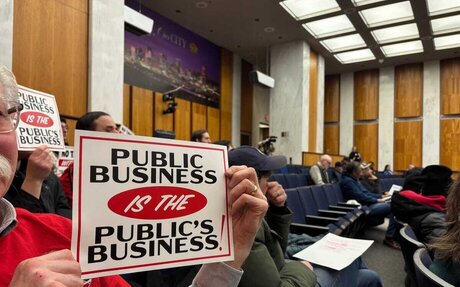
Richmond City Council on Monday night voted to create a Freedom of Information Act library, an online repository of documents requested and provided by city officials under Virginia’s FOIA. But critics questioned whether this move toward transparency is actually transparent. Megan Rhyne, executive director of the Virginia Coalition for Open Government, said the approach Council chose would “create a system where government gets to decide what the public sees.” … “The FOIA library should be a repository for the public’s records, not a curated exhibit,” she said. … Explaining her support for Avula’s ordinance, 9th District Councilwoman Nicole Jones said that “transparency without context can be very misleading.” “Just because something is out there doesn’t mean it is understandable,” she said. Gibson strongly dissented, questioning whether transparency is possible at all “when we can pick and choose what the public can see and what they can’t.” “Only … some information is not transparency,” she said. “Some information, to be frank, is how the city works now.” Prior to the vote, over a dozen people gave public comments in favor of Gibson’s ordinance. None spoke in favor of Avula’s.
|
|
|
|
Local
The Richmond City Council voted Monday to approve the creation of a city Freedom of Information Act library that will serve as an online repository of some government documents requested by citizens and the media. For months, officials have been deliberating over the specifics of how a FOIA library should work, and how much power City Hall should have to decide what information is or isn’t suitable to publish. Councilor Kenya Gibson (3rd District) had proposed a more sweeping FOIA library that would require the city to publish many documents by default. Mayor Danny Avula’s administration proposed a more narrowly crafted library that would only include documents requested by at least two people, with stricter rules in place to avoid publishing documents with sensitive or private information….The FOIA library doesn’t change what documents the city is required to release. The plan only requires the city to post the documents it releases in response to FOIA requests….Megan Rhyne, a statewide transparency advocate who serves as executive director of the Virginia Coalition for Open Government, testified in support of Gibson’s proposal saying it “correctly treats transparency as a public obligation.” “It assumes that residents do not need government to predetermine what is worthy of seeing,” Rhyne said. “It trusts that sunlight, systematically and lawfully applied, is what builds accountability and confidence in City Hall.”
|
|
|

|
Local
Remington Town Administrator Rachael Brinson has had to rifle through hundreds of pages in a three-ring binder any time there’s a question about the town’s code – until now. The code has only existed on paper since the town’s establishment, and its latest version — in a binder dated 1980 — was typed on a typewriter. The binder is lined with sticky notes Brinson uses for sections she checks frequently. Town residents and officials will finally be able to view the municipality’s laws online soon. Over the last year, Andrea Erard, an attorney specializing in local government, has worked to digitize and update the town’s code.
|
|
|
|
Higher ed
In response to a FOIA request Sept. 18 from State Sen. Creight Deeds, D-Charlottesville, the University Freedom of Information Act Office produced 284 pages of documents related to former University President Jim Ryan’s resignation and Justice Department investigations into the University. The Cavalier Daily reviewed Deeds’ original request and all the documents he received — here is what was included and what was left out. University Spokesperson Bethanie Glover wrote in a statement to The Cavalier Daily that Deeds only requested records from current members of the Board of Visitors, which may explain why some of the records were not given to him….In addition to his requests for written communications, Deeds requested records of interactions between members of the Board of Visitors and various parties involved with the resignation of Ryan or the Justice Department investigations. In particular, Deeds requested “all records of meetings, calls, conferences or other communications” including meeting and call minutes, agendas and follow-up communications. No call records or meeting information were included in the University’s release. Only four emails regarding meetings were included.
|
|
|

|
Opinion
Franklin City Council’s Nov. 24 meeting delivered something the community has long hoped to see: elected officials choosing to set aside discord and focus on the work residents expect of them. The acknowledgment came not from the council itself but from a citizen, who praised members for conducting their Nov. 10 meeting without insults, raised voices or walkouts. Her remarks were a reminder that the public is watching — and that civility matters. Disagreement is inevitable in public service. Healthy debate, grounded in respect, is often the engine that produces sound governance. What Franklin cannot afford, however, is the kind of personal hostility that overshadowed recent months, during which the city manager resigned and a planned council retreat was canceled amid internal tension. When process breaks down, so does public trust.
|
|
|
|
|
|
VCOG’s annual FOI awards nomination form is open.
Nominate your FOIA hero!
“Democracies die behind closed doors.” ~ U.S. District Judge Damon Keith, 2002
Follow us on: X / Facebook / Instagram / Threads / Bluesky
|
|
|
|