|
|
0 4 . 1 6 . 2 6
All Access
7 items
Registration closes tomorrow
Our annual conference is on April 23rd in Norfolk.
Click the image for details and registration.
THURSDAY THANKS
A big shout-out to our conference sponsors. New donors are highlighted.
You can join them by clicking here.
Boone Newsmedia • Courier-Record • Foothills Forum • The Daily Progress • The Harrisonburg Citizen • League of Women Voters of Virginia • Richmond Times-Dispatch • Sage Information Services • SPJ-VA • Virginia Association of Broadcasters • Virginia Institute for Government at UVA • Virginia Poverty Law Center • The Virginian-Pilot & Daily Press • VPM • WAVY/Fox43/CW-Hampton Roads • WHRO • WTKR • WTVR
With additional support from…
Bonnie Alexander • Tom Blackstock • Andrew Bodoh • Carolyn Caywood • Roger Christman • Maria Everett • Craig Fifer • Richard Gard • Mark Grunewald • Joshua Heslinga • Wat Hopkins • A Judd • Amanda Kastl • Laura Mollo • Patricia O’Bannon • David Poole • Megan Rhyne • Jeff South • Teshawna Threat • Clayton Tye • Sarah Vogelsong
|
|
|

|
Statewide
As the debate over the use of automatic license plate readers heated up, the Virginia Center for Investigative Journalism at WHRO requested public information about the powerful surveillance systems that blanket the state. VCIJ sent identical public records requests in June 2025 to nearly two dozen law enforcement agencies. Then came the bills. The fees for public information – collected under contracts with private security firms already costing Virginia taxpayers millions of dollars – ranged from free to $73,000. In Virginia, it’s all perfectly legal and acceptable. The Commonwealth is one of just nine states that allows unlimited hourly charges for public employees to find, review and release public information. For journalists, activists, and other Virginians who routinely file public records requests, the absence of any cap on fees often leads to steep bills, a burden that transparency advocates say discourages access and undermines open government. … Under the Virginia Freedom of Information Act, a public body can only charge for “actual cost incurred in accessing, duplicating, supplying, or searching for the requested records and shall make all reasonable efforts to supply the requested records at the lowest possible cost.” As public bodies determine “actual cost” differently, the cost of fulfilling public records requests can swing dramatically depending on who handles the work, said Megan Ryne, director of the Virginia Coalition of Open Government. The high cost of obtaining public records undermines accountability, she said
|
|
|

|
Local
Stephanie Jablonsky on Tuesday said Richmond City Council’s actions raise “First Amendment concerns” — for the second time in as many years. Jablonsky, a civil liberties attorney with the Foundation for Individual Rights and Expression (FIRE), was referring to City Council’s rules of procedure. Those rules prohibit attendees from clapping during any business-related portion of City Council meetings. “The audience will not be permitted to applaud in support of or in opposition to any matter,” the rules read. “The president of City Council may order the expulsion of any person in violation of these rules.” And indeed, Richmond residents have been threatened with ejection for applauding their peers’ public comments to their representatives. But during a marathon April 6 budget meeting, City Council President Cynthia Newbille allowed six separate rounds of applause for senior city officials who were presenting Mayor Danny Avula’s proposed financial plan for the coming year. In one case, Newbille specifically invited the crowd to clap for officials and thank them for their hard work developing the budget. To Jablonsky, Newbille’s inconsistent and self-serving application of City Council’s policies is likely an example of viewpoint discrimination forbidden by the First Amendment to the U.S. Constitution and centuries of related jurisprudence.
|
|
|

|
Local
A long-awaited forensic audit released Tuesday paints a picture of widespread breakdowns in financial controls, oversight and documentation within Martinsville’s government during the tenure of former City Manager Aretha Ferrell-Benavides. The report, conducted by Brown Edwards and finalized in January, stops short of alleging fraud but details repeated instances of noncompliance with city policies, weak or nonexistent internal controls, and spending that could not be fully justified with available documentation. The city council voted Tuesday to release the audit. Portions of the audit were redacted before public release. The council also voted to release a report at the next regular meeting of a separate workplace investigation conducted by law firm Sands Anderson.
|
|
|

|
Local
When Hopewell Mayor Johnny Partin Jr. asked Deputy City Manager Stacey Jordan, who is also Hopewell’s chief financial officer, to stand up and answer his questions about prior mismanagement, that was when tension – which was already high after the public hearing – escalated even more. … “You don’t have the authority to do this without asking the rest of council,” former councilor Debbie Randolph interjected while Jordan was answering the question. “That is unprecedented.” Partin rapped his gavel. “Ms. Randolph, we are correcting the record,” he replied. Randolph continued to talk, prompting Partin to issue a “last warning” to be quiet or be removed from the council chambers. “That’s fine. I can be escorted out, but you’re doing something you have no authority to do,” she said. At that point, Partin directed a sheriff’s deputy “to escort Ms. Randolph out of this meeting.” … [After having another resident removed,] one citizen in the rear of the gallery then said, “Why don’t you just remove all of us?”
|
|
|

|
Local
A Loudoun County Circuit Court judge on Wednesday dismissed a lawsuit brought by three members of the Purcellville Town Council requesting clarification on whether state code requires a two-thirds majority vote to adopt a tax rate. Judge James E. Plowman ruled no legal rights were being infringed. The suit was submitted by councilmembers Erin Rayner, Caleb Stought, and Kevin Wright after the Purcellville Town Council last year adopted tax rates with a simple majority and then again, this year adopted a tax rate with a simple majority. Historically, Loudoun’s towns have operated under the belief that a two-thirds majority was required adopt a tax rate. A four-hour trial on the case was scheduled for Wednesday morning. However, Plowman dismissed the suit after determining that no legal rights were being infringed, which keeps the case from rising to the level of “actual controversy” on which the court could opine.
|
|
|

|
In other states-Connecticut
Police departments cannot claim that generating an audit report for access to body-worn camera footage requires creating a new document to avoid Freedom of Information Act (FOIA) disclosure, according to a recent ruling from the Connecticut Freedom of Information Commission (FOIC). While FOIA requires public agencies to turn over non-exempt public records upon request, it does not require agencies to generate documents that do not already exist or to answer questions about existing documents. The South Windsor Police Department used this provision to deny a request for audit trail reports for body-worn camera and patrol vehicle videos. Audit logs, which exist for a variety of technologies used by police, contain information about who accessed catalogued information and when.
|
|
|
|
In other states-Colorado
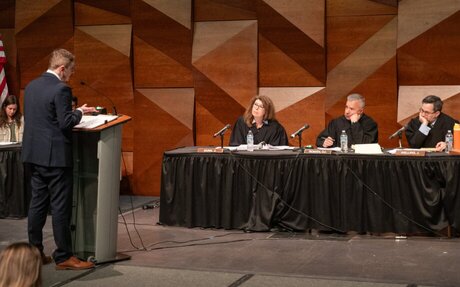
Colorado’s Law Enforcement Integrity Act does not permit agencies to charge fees as a condition of releasing body-worn camera footage depicting possible misconduct by police officers, the Colorado Court of Appeals decided last week. Affirming a 2024 district court ruling, a three-judge appellate panel said the “conspicuous absence of a fee provision in the Integrity Act is telling.” “After all, the General Assembly knows how to include a fee provision if it intends one because the CCJRA [Colorado Criminal Justice Records Act] plainly allows a criminal justice agency discretion to charge reasonable fees to review and produce criminal justice records.”
|
|
|
|
|
|
|
|
|